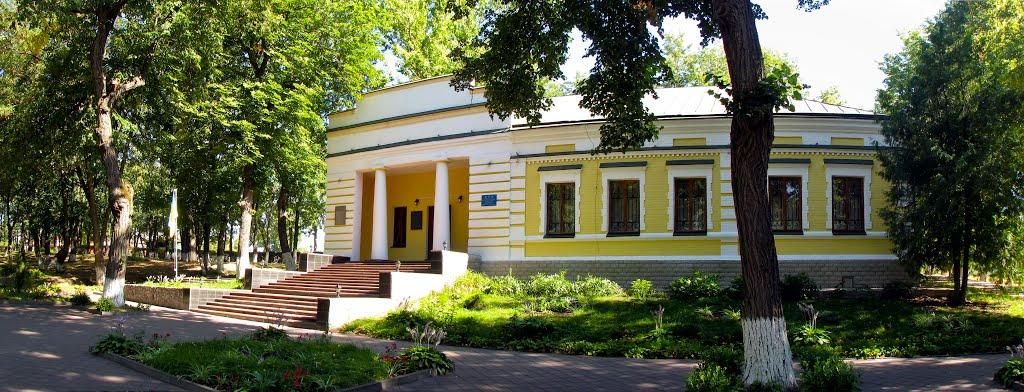
The architectural monument was erected in 1831 in the central part of the city of Chuguev. The hallmark of the building is a tower with a spire. The building was built to house the corps of divisional military settlements of Sloboda Ukraine, according to the project of the architect Vasily Stasov.
The architectural monument was erected in 1831 in the central part of the city of Chuguev. The hallmark of the building is a tower with a spire. The building was built to house the corps of divisional military settlements of Sloboda Ukraine, according to the project of the architect Vasily Stasov.
For the first time they spoke of the need to build a building for military garrisons in 1831. Then the construction of the headquarters of military settlements began. The author of the project was the architect Vasily Petrovich Stasov.
In the 1950s, two wings were added to the building. Such changes were due to lack of space for the administration of the eighth Ukrainian military district and the corps of topographers of the Russian Empire.
Here is what Repin recalled about his visit to the corps: “Afterwards I found out that topographical students were seconded from various cavalry regiments to the topographers corps; they wore uniforms of their regiments. That is why Bondarev was not in the form of a topographer. Soon from other halls, a handful of ten cantonists walked past us behind their teacher, also a topographer; everyone has a written notebook in their hands. The teacher indicated the place on the map with a stick, and they shouted out loud the names of countries, rivers, mountains, cities, seas, bays, straits, etc. I really liked these cantonists in military jackets and breeches. Now, if I dressed like that! No, ashamed. They so briskly answered their teacher questions and quickly indicated places on maps. Everything was studied quickly, loudly and cheerfully - and the complex German Union and the specific system of the great Russian princes and principalities. I learned all this after, of course, when I began to study right there. ”
Over the years, the building housed various educational institutions specializing in military craft: the headquarters of military settlements, the Chuguev cadet infantry school, and the Kharkov Suvorov school.
From 1865 to 1918, the Chuguev Infantry Junker School was located on the territory of the Headquarters of military settlements.
From 1943 to 1947, the building housed the Kharkov Suvorov School.
In 2010, the building was transferred to the society of the City Municipality, which was a turning point for the former headquarters of military settlements. Now on its territory there is an art gallery, the exposition of which presents the works of outstanding artists of the Chuguev region and laureates of the Repin Prize.
The architecture of the building is decided in the style of classicism. Strict rhythm and the alternation of window openings make the facade majestic and monumental.
The exposition of the museum totals more than 1000 exhibits of pictorial, sculptural and decorative art of Slobozhanshchina.
For the first time they spoke of the need to build a building for military garrisons in 1831. Then the construction of the headquarters of military settlements began. The author of the project was the architect Vasily Petrovich Stasov.
In the 1950s, two wings were added to the building. Such changes were due to lack of space for the administration of the eighth Ukrainian military district and the corps of topographers of the Russian Empire.
Here is what Repin recalled about his visit to the corps: “Afterwards I found out that topographical students were seconded from various cavalry regiments to the topographers corps; they wore uniforms of their regiments. That is why Bondarev was not in the form of a topographer. Soon from other halls, a handful of ten cantonists walked past us behind their teacher, also a topographer; everyone has a written notebook in their hands. The teacher indicated the place on the map with a stick, and they shouted out loud the names of countries, rivers, mountains, cities, seas, bays, straits, etc. I really liked these cantonists in military jackets and breeches. Now, if I dressed like that! No, ashamed. They so briskly answered their teacher questions and quickly indicated places on maps. Everything was studied quickly, loudly and cheerfully - and the complex German Union and the specific system of the great Russian princes and principalities. I learned all this after, of course, when I began to study right there. ”
Over the years, the building housed various educational institutions specializing in military craft: the headquarters of military settlements, the Chuguev cadet infantry school, and the Kharkov Suvorov school.
From 1865 to 1918, the Chuguev Infantry Junker School was located on the territory of the Headquarters of military settlements.
From 1943 to 1947, the building housed the Kharkov Suvorov School.
In 2010, the building was transferred to the society of the City Municipality, which was a turning point for the former headquarters of military settlements. Now on its territory there is an art gallery, the exposition of which presents the works of outstanding artists of the Chuguev region and laureates of the Repin Prize.
The architecture of the building is decided in the style of classicism. Strict rhythm and the alternation of window openings make the facade majestic and monumental.
The exposition of the museum totals more than 1000 exhibits of pictorial, sculptural and decorative art of Slobozhanshchina.