House of Karol Halpern
Karol Halpern belonged to one of the most influential Halpern families in ...
Until 1939, this building housed one of the most powerful mills in the region, which belonged to the owner Rudolph. During the occupation of the city, the Nazis made a "camp" for Jews here from April to October 1942, which became a real "mill of death". In Soviet times and in the 1990s and 2000s, a sewing factory operated here, and now the reconstructed building houses office and retail premises.
Until 1939, this building housed one of the most powerful mills in the region, which belonged to the owner Rudolph. During the occupation of the city, the Nazis made a "camp" for Jews here from April to October 1942, which became a real "mill of death". In Soviet times and in the 1990s and 2000s, a sewing factory operated here, and now the reconstructed building houses office and retail premises.
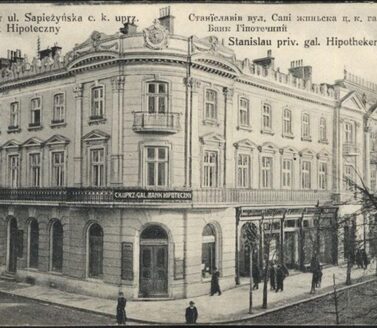
Karol Halpern belonged to one of the most influential Halpern families in ...
With the beginning of the German-Soviet war on 06/22/1941 and the occupation of the city on 07/02/1941 first by the Hungarians, and on 08/01/1941 by the Nazis, several thousand starving and exhausted Jews - refugees from Hungary - found shelter in Rudolph's mill. The Judenrat organized a kitchen for them, a doctor worked, but there was a catastrophic lack of food, and most of them, mostly children, died of hunger and cold in the winter of 1941–1942. Those who survived were deported to Belzec death camp on March 31, 1942. Several hundred patients remained at the mill, who were "isolated" from other residents of the Stanislavsky ghetto.
But only until April 1942, the mill belonged to the territory of the so-called of the "open" ghetto, since the transformation of the ghetto into a "labor camp" began. In April 1942, Jews were "classified" into prisoners of different categories: "A" - working (remained in the center of the ghetto, which was closed on April 20, 1942); "B" - labor reserve (they were settled on the "islands" on Halytskaya and Skargy Streets), "C" - the sick, infirm, disabled, unemployed, elderly, and sometimes over 50 years old (sent to the "camp"). The state policy of Jewish genocide unleashed by the Nazis of the Third Reich, after the destruction of the intelligentsia of the city in August 03–08.08.1941 and the first mass executions on 10.12.1941 and deportation on 03.31.1942, continued with the extermination of the "unfit for work". Their concentration (both from Stanislavsky, including refugees from other countries, and those "resettled" into the city from Stanislavsky District) took place in the so-called "camps": Rudolph's mills and Shuzman's factory.
Under the control of the Gestapo and the police, up to three thousand "unfit for work" from the Stanislaus ghetto were first taken to these "camps". For this category, it was effectively a death sentence. They knew about the fate of the camp's inhabitants, so they paid huge sums of money for the poison, just to avoid getting into the "mill of death" alive. In the camps, it was impossible to place such a large number of condemned at the same time, so the rooms on the first floors were actually turned into death chambers. According to A. Liebesman, in the "death mill" people were "prepared for death through exhaustion and torture." Inadequate housing, unsanitary conditions, hunger, cold, and diseases led to the fact that 20-30 people died at the mill every day. They were buried right there in the yard, under the wall, or they were taken to the Jewish cemetery. For the purpose of "prevention", the Gestapo and the police regularly visited the camps. During such checks, first of all, they shot children, then the sick, women, and the elderly, thus "freeing up" places. The condemned were actually shot near the wall and buried there. Gravediggers were members of the so-called "volunteer fire brigade" (50 people), which was also located at the mill. Among those who survived the Holocaust was Horowitz, the son of the fire chief of the ghetto. According to his stories, "the camp on Dovgiy was actually a prison in the ghetto. The room near the sewing factory was filled to the ceiling with corpses, blood flowed along Dovga all the way to Halytska."
On April 12, 1942, an action began at the mill, during which completely exhausted residents of the "death mill" were taken to the Jewish cemetery and thrown into pits alive. From April 12 to 19, 1942, about three thousand were murdered.
But the population of the "camp" was constantly replenished. From the spring of 1942, Jews from the Stanislavsky district (that is, from the former districts of the region: Bogorodchanskyi, Voynilivskyi, Halytskyi, Zhovtnevskyi, Kalusskyi, Lysetskyi, Nadvirnyanskyi, Otyniyskyi, Solotvynskyi, Tysmenyskyi, Tlumatskyi) were brought to Stanislav every day, "placing them in both camps ", as Yudenrat member Y. Feuerman mentioned in his diary. From here, only a small part of them ended up in the ghetto. In total, about 20,000 Jews passed through Stanislav, some were deported to Belzhets, some were immediately shot at the place of mass execution of Jews in Prykarpattia - the Jewish cemetery, the rest were placed in these "camps".
On May 7, 1942, 600 Jews were shot at the mill. In the period from July to October 1942, every Saturday (on a holy day for Jews), the prisoners of the "death mill" were taken in groups of 500 to be shot at the cemetery.
"The mill was soon liquidated because it was supposedly too close to the center. There they opened a knitting shop and a German ready-made clothing shop...". The knitting workshop and the factory of ready-made clothes (on Halytskaya St., now building No. 101) were one of the last enterprises that the Nazis allowed to open. 300-340 Jewish women were forced to work for them without pay.
During the liquidation of the "death mill" in October 1942, among the doomed was the fiancee of the head of the Jewish Service of Order Ziggy Weiss (the daughter of the former director of the sawmill Glesinger, who was also there). Weiss, who did not have to escort these candidates to death, nevertheless followed the escort to the cemetery, once again begging SS Schott to pardon the bride. "Ziggy, go away!" - answered Schott, and when Weiss repeated his request, Schott shot first him, and then the girl.
More than 3,000 people were murdered at the "death mill", most of them are buried in the Jewish cemetery, and about a thousand Jews were shot under the wall on the territory of the mill during actions on 08/28/1942, 09/04/1942, 09/19/1942, 09/26/1942 , 03.10.1942.
With the beginning of the German-Soviet war on 06/22/1941 and the occupation of the city on 07/02/1941 first by the Hungarians, and on 08/01/1941 by the Nazis, several thousand starving and exhausted Jews - refugees from Hungary - found shelter in Rudolph's mill. The Judenrat organized a kitchen for them, a doctor worked, but there was a catastrophic lack of food, and most of them, mostly children, died of hunger and cold in the winter of 1941–1942. Those who survived were deported to Belzec death camp on March 31, 1942. Several hundred patients remained at the mill, who were "isolated" from other residents of the Stanislavsky ghetto.
But only until April 1942, the mill belonged to the territory of the so-called of the "open" ghetto, since the transformation of the ghetto into a "labor camp" began. In April 1942, Jews were "classified" into prisoners of different categories: "A" - working (remained in the center of the ghetto, which was closed on April 20, 1942); "B" - labor reserve (they were settled on the "islands" on Halytskaya and Skargy Streets), "C" - the sick, infirm, disabled, unemployed, elderly, and sometimes over 50 years old (sent to the "camp"). The state policy of Jewish genocide unleashed by the Nazis of the Third Reich, after the destruction of the intelligentsia of the city in August 03–08.08.1941 and the first mass executions on 10.12.1941 and deportation on 03.31.1942, continued with the extermination of the "unfit for work". Their concentration (both from Stanislavsky, including refugees from other countries, and those "resettled" into the city from Stanislavsky District) took place in the so-called "camps": Rudolph's mills and Shuzman's factory.
Under the control of the Gestapo and the police, up to three thousand "unfit for work" from the Stanislaus ghetto were first taken to these "camps". For this category, it was effectively a death sentence. They knew about the fate of the camp's inhabitants, so they paid huge sums of money for the poison, just to avoid getting into the "mill of death" alive. In the camps, it was impossible to place such a large number of condemned at the same time, so the rooms on the first floors were actually turned into death chambers. According to A. Liebesman, in the "death mill" people were "prepared for death through exhaustion and torture." Inadequate housing, unsanitary conditions, hunger, cold, and diseases led to the fact that 20-30 people died at the mill every day. They were buried right there in the yard, under the wall, or they were taken to the Jewish cemetery. For the purpose of "prevention", the Gestapo and the police regularly visited the camps. During such checks, first of all, they shot children, then the sick, women, and the elderly, thus "freeing up" places. The condemned were actually shot near the wall and buried there. Gravediggers were members of the so-called "volunteer fire brigade" (50 people), which was also located at the mill. Among those who survived the Holocaust was Horowitz, the son of the fire chief of the ghetto. According to his stories, "the camp on Dovgiy was actually a prison in the ghetto. The room near the sewing factory was filled to the ceiling with corpses, blood flowed along Dovga all the way to Halytska."
On April 12, 1942, an action began at the mill, during which completely exhausted residents of the "death mill" were taken to the Jewish cemetery and thrown into pits alive. From April 12 to 19, 1942, about three thousand were murdered.
But the population of the "camp" was constantly replenished. From the spring of 1942, Jews from the Stanislavsky district (that is, from the former districts of the region: Bogorodchanskyi, Voynilivskyi, Halytskyi, Zhovtnevskyi, Kalusskyi, Lysetskyi, Nadvirnyanskyi, Otyniyskyi, Solotvynskyi, Tysmenyskyi, Tlumatskyi) were brought to Stanislav every day, "placing them in both camps ", as Yudenrat member Y. Feuerman mentioned in his diary. From here, only a small part of them ended up in the ghetto. In total, about 20,000 Jews passed through Stanislav, some were deported to Belzhets, some were immediately shot at the place of mass execution of Jews in Prykarpattia - the Jewish cemetery, the rest were placed in these "camps".
On May 7, 1942, 600 Jews were shot at the mill. In the period from July to October 1942, every Saturday (on a holy day for Jews), the prisoners of the "death mill" were taken in groups of 500 to be shot at the cemetery.
"The mill was soon liquidated because it was supposedly too close to the center. There they opened a knitting shop and a German ready-made clothing shop...". The knitting workshop and the factory of ready-made clothes (on Halytskaya St., now building No. 101) were one of the last enterprises that the Nazis allowed to open. 300-340 Jewish women were forced to work for them without pay.
During the liquidation of the "death mill" in October 1942, among the doomed was the fiancee of the head of the Jewish Service of Order Ziggy Weiss (the daughter of the former director of the sawmill Glesinger, who was also there). Weiss, who did not have to escort these candidates to death, nevertheless followed the escort to the cemetery, once again begging SS Schott to pardon the bride. "Ziggy, go away!" - answered Schott, and when Weiss repeated his request, Schott shot first him, and then the girl.
More than 3,000 people were murdered at the "death mill", most of them are buried in the Jewish cemetery, and about a thousand Jews were shot under the wall on the territory of the mill during actions on 08/28/1942, 09/04/1942, 09/19/1942, 09/26/1942 , 03.10.1942.