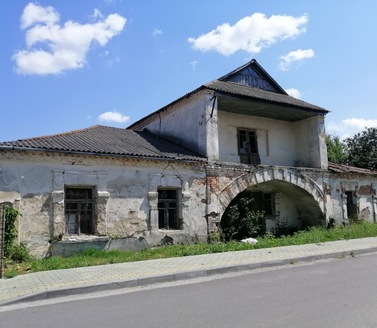
Hostelry
It is located in the central historical district of the city. The nature of ...
The monument (guard No. 765) is located in the historical part of the city at the confluence of the Sluch and Ikopot rivers. Its constituent parts, which have survived to this day: Church, Palace, Gate with a wall, Tower-donjon, Bell.
The Holy Trinity Church (the family church of the princes of Ostrog) is located close to the castle. Its bell tower was built in the 18th century. The church is well preserved. Its architectural details are a combination of several styles: Gothic and Baroque.
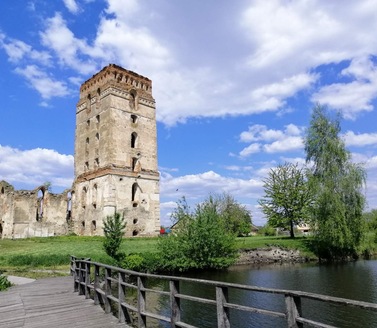
The princely palace is a two-story building. The walls are made of brick. The Palace of the Ostrogs can be conditionally divided into two parts: the military (Basta-donjon) and the secular (residence with a family church). The defense tower is two-story, with gun emplacements. In the architecture of the castle, you can notice the Renaissance style - the top of the tower-donjon is decorated with a typical two-story attic, which was characteristic of all the buildings of the Ostroh principality.
Today, the castle houses a portrait gallery of the family of Ostrozki princes, a coat of arms room, a round (princely) chamber and other museum exhibits.
The monument (guard No. 765) is located in the historical part of the city at the confluence of the Sluch and Ikopot rivers. Its constituent parts, which have survived to this day: Church, Palace, Gate with a wall, Tower-donjon, Bell.
The Holy Trinity Church (the family church of the princes of Ostrog) is located close to the castle. Its bell tower was built in the 18th century. The church is well preserved. Its architectural details are a combination of several styles: Gothic and Baroque.
The princely palace is a two-story building. The walls are made of brick. The Palace of the Ostrogs can be conditionally divided into two parts: the military (Basta-donjon) and the secular (residence with a family church). The defense tower is two-story, with gun emplacements. In the architecture of the castle, you can notice the Renaissance style - the top of the tower-donjon is decorated with a typical two-story attic, which was characteristic of all the buildings of the Ostroh principality.
Today, the castle houses a portrait gallery of the family of Ostrozki princes, a coat of arms room, a round (princely) chamber and other museum exhibits.
It is located in the historical part of the city on the left bank of the ...
The founder is Prince Vasyl-Kostyantyn Ostrozky. Built in a fairly short period (1561-1571), the castle was part of the defense system of the Volyn lands, which served as protection against Tatar invasions. Starokostiantyn Castle was built on the banks of the Sluch and Ikopot rivers, which ensured its impregnability. In front of the entrance gate (the 1st floor has survived to our time), a drawbridge was built over the moat that separated the Castle from the city.
From 1929 to 1954, the State Historical and Cultural Reserve operated on the basis of the Castle.
During the German occupation, the Castle housed the German headquarters, some premises were converted into barracks. Immediately after the liberation of the city, in 1944, the museum began to operate again. Until the 1980s, the premises of the castle housed: a sports school, the Voluntary Society for the Promotion of the Army, Aviation and Navy, a salting base, etc. In 2013, the historical and cultural center-museum "Old Konstantinov" was opened in the castle of the Ostrozh princes.
The founder is Prince Vasyl-Kostyantyn Ostrozky. Built in a fairly short period (1561-1571), the castle was part of the defense system of the Volyn lands, which served as protection against Tatar invasions. Starokostiantyn Castle was built on the banks of the Sluch and Ikopot rivers, which ensured its impregnability. In front of the entrance gate (the 1st floor has survived to our time), a drawbridge was built over the moat that separated the Castle from the city.
From 1929 to 1954, the State Historical and Cultural Reserve operated on the basis of the Castle.
During the German occupation, the Castle housed the German headquarters, some premises were converted into barracks. Immediately after the liberation of the city, in 1944, the museum began to operate again. Until the 1980s, the premises of the castle housed: a sports school, the Voluntary Society for the Promotion of the Army, Aviation and Navy, a salting base, etc. In 2013, the historical and cultural center-museum "Old Konstantinov" was opened in the castle of the Ostrozh princes.