THE EQUESTRIAN THEATER “ZAPORIZHSKI COSSACKS”
Horse theater "Zaporizhzhya Cossacks" folklore-ethnographic ensemble of. ...
Khortytsia is a centre of natural and historical heritage in Zaporizhzhia. Rocky Dnipro banks, steppe and wetlands meet monuments from many periods. Archaeological finds reveal ancient settlement, sanctuaries, burial traditions and the island’s role in the Dnipro region.
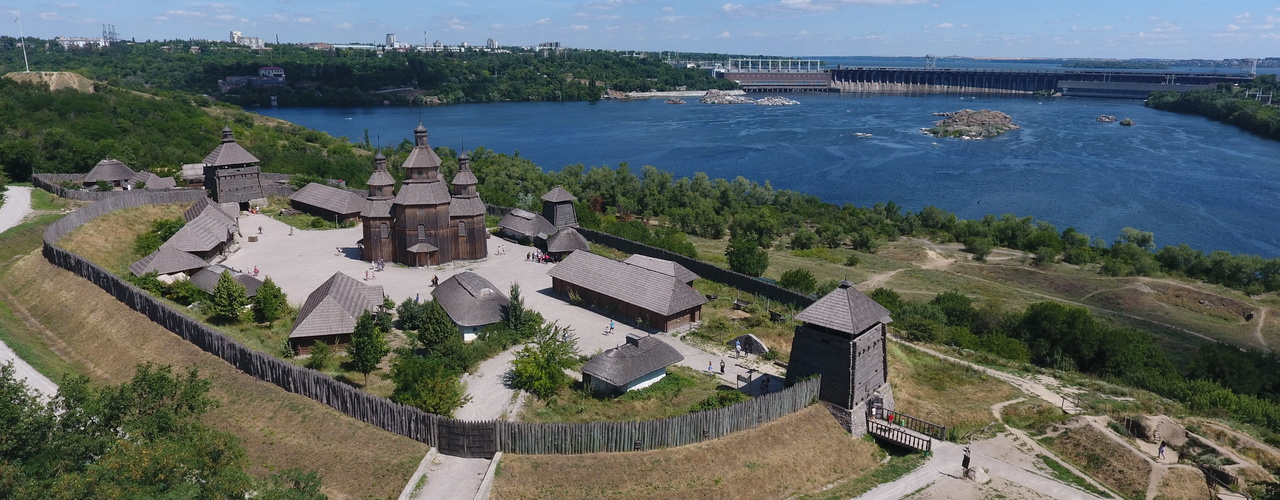
The Museum of the History of the Zaporizhian Cossacks and the Zaporizhian Sich historical and cultural complex explore Cossack heritage. The complex recreates a generalised image of a Cossack capital, presenting everyday life, beliefs and military traditions. Its history also includes performances by the Sich Cossacks reenactment group.
Archaeological sites include ancient sanctuaries, some interpreted as places for observing celestial bodies. Scythian Camp brings together original and reconstructed burial mounds with an open-air collection of stone monuments. The Museum of Navigation preserves vessels recovered through underwater research in the Dnipro.
The southern island and the Protovche area represent a wetland landscape of lakes and aquatic vegetation. Diverse habitats support numerous plants, insects, birds and mammals, including rare species. Khortytsia’s natural heritage is inseparable from its historical significance.
Khortytsia is a centre of natural and historical heritage in Zaporizhzhia. Rocky Dnipro banks, steppe and wetlands meet monuments from many periods. Archaeological finds reveal ancient settlement, sanctuaries, burial traditions and the island’s role in the Dnipro region.
The Museum of the History of the Zaporizhian Cossacks and the Zaporizhian Sich historical and cultural complex explore Cossack heritage. The complex recreates a generalised image of a Cossack capital, presenting everyday life, beliefs and military traditions. Its history also includes performances by the Sich Cossacks reenactment group.
Archaeological sites include ancient sanctuaries, some interpreted as places for observing celestial bodies. Scythian Camp brings together original and reconstructed burial mounds with an open-air collection of stone monuments. The Museum of Navigation preserves vessels recovered through underwater research in the Dnipro.
The southern island and the Protovche area represent a wetland landscape of lakes and aquatic vegetation. Diverse habitats support numerous plants, insects, birds and mammals, including rare species. Khortytsia’s natural heritage is inseparable from its historical significance.
By bus number 46, 93 or 45, trolley bus number 3 from the Cathedral Avenue to the stop "Molodezhnaya" (Mikhailov Street), then walk through the park and the arched bridge. Or transport, moving to Khortitsky district (Baburka) through Khortitsa.
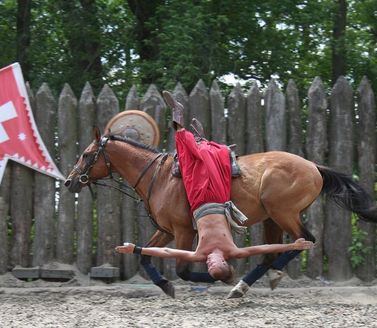
Horse theater "Zaporizhzhya Cossacks" folklore-ethnographic ensemble of. ...
Khortytsia’s history began long before the rise of the Zaporizhian Cossacks. Ancient settlements, sanctuaries and burial mounds testify to long occupation and changing cultures in the Dnipro region. Rocky banks, steppe and wetlands shaped the lives of its inhabitants.
A major chapter of Cossack history is associated with Prince Dmytro Vyshnevetsky. In the 1550s he built a fortress on neighbouring Mala Khortytsia, also called Baida. It is regarded as one of the precursors of the Zaporizhian Sich and should not be confused with the modern historical and cultural complex on the main island.
The state historical and cultural reserve was established on 18 September 1965. It received national status on 6 April 1993. The protected area provided a framework for preserving, researching and presenting the island’s natural and historical heritage.
Museum collections, archaeological sites and the reconstructed Zaporizhian Sich reveal different layers of this history, from ancient sacred places to Cossack traditions and navigation on the Dnipro.
Khortytsia’s history began long before the rise of the Zaporizhian Cossacks. Ancient settlements, sanctuaries and burial mounds testify to long occupation and changing cultures in the Dnipro region. Rocky banks, steppe and wetlands shaped the lives of its inhabitants.
A major chapter of Cossack history is associated with Prince Dmytro Vyshnevetsky. In the 1550s he built a fortress on neighbouring Mala Khortytsia, also called Baida. It is regarded as one of the precursors of the Zaporizhian Sich and should not be confused with the modern historical and cultural complex on the main island.
The state historical and cultural reserve was established on 18 September 1965. It received national status on 6 April 1993. The protected area provided a framework for preserving, researching and presenting the island’s natural and historical heritage.
Museum collections, archaeological sites and the reconstructed Zaporizhian Sich reveal different layers of this history, from ancient sacred places to Cossack traditions and navigation on the Dnipro.