Jesuit Monastery
It is the oldest still-standing brick building in Vinnytsia which has become ...
Artynov Tower as a magnet attracts to the European Square Vinnytsia residents and guests. Shady alleys of the park, the song of a fountain, floral and coffee aromas and the festive clock chimes - this cozy picture is just asking to be on a souvenir card.
And only the majestic tower remembers turbulent times of the past and keeps the memory of shocking events in the life of Vinnytsia. No wonder it is now the main symbol of the city
Artynov Tower as a magnet attracts to the European Square Vinnytsia residents and guests. Shady alleys of the park, the song of a fountain, floral and coffee aromas and the festive clock chimes - this cozy picture is just asking to be on a souvenir card.
And only the majestic tower remembers turbulent times of the past and keeps the memory of shocking events in the life of Vinnytsia. No wonder it is now the main symbol of the city
It is the oldest still-standing brick building in Vinnytsia which has become ...
More than a hundred years ago, Vinnytsia was already considered extremely ...
In the midst of the noisy, modern city center there is an ascetic ancient ...
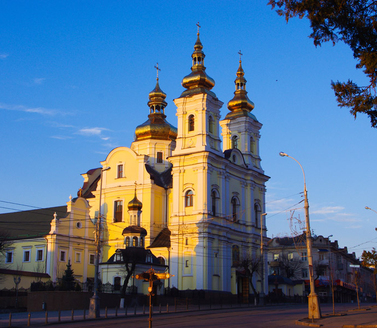
Its domes glistening in the sun and heading for the blue sky can be seen ...
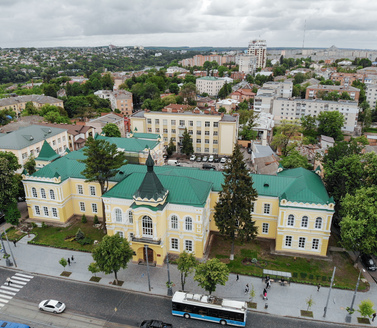
The former Non-classical Secondary School is one of the buildings which form ...
It is the most noticeable modern building in the center of Vinnytsia. When ...
The first six-level building has been decorating a central Vinnytsia street ...
The Tower was built in 1911 in response to the needs for water supply: a rapidly developing city stimulated progress in this area. City architect Hryhorii Artynov was the author of the project on tower erection and water supply. It had functions of a firefighting tower with an observation deck at the same time. The Tower is built in a style of historicism, being typical for constructions at those times.
The brickwork of the walls, a massive base, and the clock gave the six-storied octagonal building an image of an early modern town hall. It served as a water and firefighting tower till World War II when it became an observation post. Traces of cannon shots forever engraved this period on its walls and they still remind of those hardships. On March 20, 1944, the flag was raised up at the very top of the Tower as a sign of kicking the Nazis out of Vinnytsia.In the post-war period, there was a residential house in a brick building: apartments were allocated to Vodokanal employees.
And in the early 1980s, there was a reconstruction and, as a result, the Tower got its current appearance. In 1985 apartments were changed into the Museum of Revolutionary and Military Glory, and later, in 1993, into the Museum of Soldiers of Vinnytsia Region, opened in honor of those killed in the undeclared Afghan war. Today, as more than a century ago, the clock on the Tower tells the exact time to the residents of the city. In the evening time the building is illuminated, creating a unique atmosphere on the square.
The Tower was built in 1911 in response to the needs for water supply: a rapidly developing city stimulated progress in this area. City architect Hryhorii Artynov was the author of the project on tower erection and water supply. It had functions of a firefighting tower with an observation deck at the same time. The Tower is built in a style of historicism, being typical for constructions at those times.
The brickwork of the walls, a massive base, and the clock gave the six-storied octagonal building an image of an early modern town hall. It served as a water and firefighting tower till World War II when it became an observation post. Traces of cannon shots forever engraved this period on its walls and they still remind of those hardships. On March 20, 1944, the flag was raised up at the very top of the Tower as a sign of kicking the Nazis out of Vinnytsia.In the post-war period, there was a residential house in a brick building: apartments were allocated to Vodokanal employees.
And in the early 1980s, there was a reconstruction and, as a result, the Tower got its current appearance. In 1985 apartments were changed into the Museum of Revolutionary and Military Glory, and later, in 1993, into the Museum of Soldiers of Vinnytsia Region, opened in honor of those killed in the undeclared Afghan war. Today, as more than a century ago, the clock on the Tower tells the exact time to the residents of the city. In the evening time the building is illuminated, creating a unique atmosphere on the square.