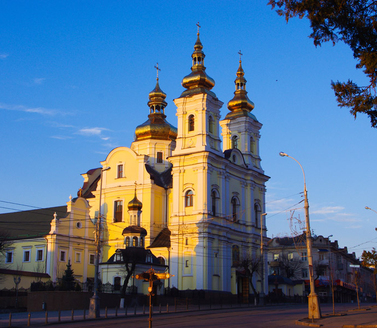
Jesuit Monastery
It is the oldest still-standing brick building in Vinnytsia which has become ...
In the midst of the noisy, modern city center there is an ascetic ancient temple of the Capuchin Order. The founder of the monastery was Ludwig Kalinowski, Vinnytsia elected head, who in 1746 invited the Order of Friars Minor Capuchin to the city. At that time, the monastery was located on the outskirts of the city, and there was a forest at the back of it. Fifteen years later, the temple has been completely constructed at the St. Francis Capuchin monastery and consecrated under the wing of the Virgin Mary of the Angel. The Rule of Order forbade unnecessary decorations, so the temple was built in Tuscan Baroque – the repressed style with magnificent and expressive forms. To the left there were monk’s cells, to the right – a bell tower. The religious house had also a system of underground accommodation with the purpose to protect against enemy attacks and store food, there were also basements under the temple for coffins. These basements were tunneled with Vinnytsia catacombs - underground passages that connected important objects of urban infrastructure in the 17th - 18th centuries.
It is the oldest still-standing brick building in Vinnytsia which has become ...
More than a hundred years ago, Vinnytsia was already considered extremely ...
Its domes glistening in the sun and heading for the blue sky can be seen ...
It is the most noticeable modern building in the center of Vinnytsia. When ...
The first six-level building has been decorating a central Vinnytsia street ...
The monastery belonged to the Capuchins until 1888, after that they were forced to leave their last religious house on the territory of Ukraine according to the decree of the tsar. They sought shelter in the Polish-Lithuanian Commonwealth. Some of them changed into priestly garbs and served in Roman Catholic parishes. Monk’s cells were transformed into tsar barracks. Only eparchial priests were allowed to serve in the temple. During the Ukrainian revolution in 1917‒1921 the Ministry of Cults (religion) of the Ukrainian People’s Republic was housed here. In the 1930s a part of the premises was rebuilt and transformed into an aero club and a dwelling house, and in the 1960s the temple was rebuilt to be used as a lecture hall, completely demolishing the temple elements. Its basement was then used as a bomb shelter.
In 1990 the Catholic community obtained this temple building and two years later Capuchins came back to Vinnytsia to their old-established religious house. In the late 1990s, an organ was installed in the temple. It had been restored from the wreckage of the instrument that survived after the neighboring cathedral (former Organ Hall of the Philharmonic) was given to representatives of the Orthodox parish.
During the years of independent Ukraine, the monastery has not only been repaired but it also received back its original architectural image. There are sculptures of saints and the Mother of God with a baby on the main facade, a bell tower has been rebuilt to the right of the entrance. A monument to John Paul II was later erected in its portal. The music of the organ can be heard during services and concerts of the annual autumn festival "Music in the monastery walls." The monastery dungeon is still scantily explored. However, a part of it is already open and even available for excursions, at which you can find out about the centuries-old functionality and legends of Vinnytsia catacombs.
The monastery belonged to the Capuchins until 1888, after that they were forced to leave their last religious house on the territory of Ukraine according to the decree of the tsar. They sought shelter in the Polish-Lithuanian Commonwealth. Some of them changed into priestly garbs and served in Roman Catholic parishes. Monk’s cells were transformed into tsar barracks. Only eparchial priests were allowed to serve in the temple. During the Ukrainian revolution in 1917‒1921 the Ministry of Cults (religion) of the Ukrainian People’s Republic was housed here. In the 1930s a part of the premises was rebuilt and transformed into an aero club and a dwelling house, and in the 1960s the temple was rebuilt to be used as a lecture hall, completely demolishing the temple elements. Its basement was then used as a bomb shelter.
In 1990 the Catholic community obtained this temple building and two years later Capuchins came back to Vinnytsia to their old-established religious house. In the late 1990s, an organ was installed in the temple. It had been restored from the wreckage of the instrument that survived after the neighboring cathedral (former Organ Hall of the Philharmonic) was given to representatives of the Orthodox parish.
During the years of independent Ukraine, the monastery has not only been repaired but it also received back its original architectural image. There are sculptures of saints and the Mother of God with a baby on the main facade, a bell tower has been rebuilt to the right of the entrance. A monument to John Paul II was later erected in its portal. The music of the organ can be heard during services and concerts of the annual autumn festival "Music in the monastery walls." The monastery dungeon is still scantily explored. However, a part of it is already open and even available for excursions, at which you can find out about the centuries-old functionality and legends of Vinnytsia catacombs.