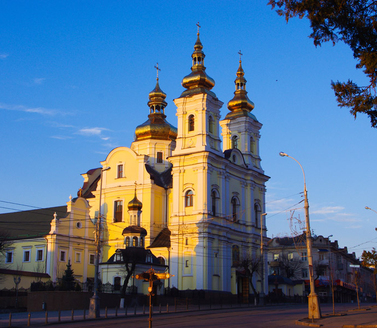
VINNYTSIA

Jesuit Monastery

Description

  • It is the oldest still-standing brick building in Vinnytsia

It is the oldest still-standing brick building in Vinnytsia which has become an old witness to uprisings, revolutions and wars over more than 400-year history. This building used to perform various functions: it housed educational institutions, it hid from invaders, soldiers were dislocated here, newspapers were printed here, but at first this place was one of the Jesuit centers.

It is the oldest still-standing brick building in Vinnytsia which has become an old witness to uprisings, revolutions and wars over more than 400-year history. This building used to perform various functions: it housed educational institutions, it hid from invaders, soldiers were dislocated here, newspapers were printed here, but at first this place was one of the Jesuit centers.

Moreinfo · ENG 12

How to get there?

And also nearby

HISTORY

  • Before the 20th century although the Mury had a period of decline, they kept their functions even after the dissolution of the Jesuit order.

In 1610 Valienta-Oleksandr Kalynovskyi, General of Podillia and the elected head of Bratslav, founded a permanent center of the Jesuit order in Vinnytsia, later providing Catholic monks with their own land plot and considerable money for construction. Giacomo Briano, the Italian, is believed to be the architect of the monastery. The complex of the Society of Jesus consisted of a church, cells, crypt basements, a bell tower, a dormitory and a school building. After the monastery had been completely constructed, the Jesuits built a thick brick wall with towers at the corners. The monastery complex is located in the upland part of the right bank. The degree of reliability and durability of buildings and structures is quite impressive, and therefore the name Mury (derived from the Latin murus - wall) stuck to them. Hereupon the concept of a complex architectural object of the Mury came to the fore, and in a century it was joined by another monastery - the Dominican one. At this time, Vinnytsia became an administrative and economic center of Bratslav Voivodeship (Bratslav Province) in the eastern part of the Polish-Lithuanian Commonwealth. And the fortress played a significant role during enemy attacks. In addition, the complex of monastic buildings became an important cult and educational center of Vinnytsia

Before the 20th century although the Mury had a period of decline, they kept their functions even after the dissolution of the Jesuit order. In 1814 a gymnasium was opened here, at the same time the walls of the Mury housed a prison and a treasury. During the Russian empire and in the days of the Soviet Union the Monastery housed educational institutions, a military hospital, barracks, a firefighting unit, an Orthodox church, a gym room, a council of workers' deputies, a museum with a library, an archive office, a newspaper editorial office, an office of Dynamo company and even a cinema.

The monastic complex remained unfinished despite its strong fortifications and over the years of its existence still suffered significant damage due to plunder, fire, attacks, change of owners, lack of proper repairs and time. At the end of the 19th century the south wing had to be demolished and later the facade wall collapsed.

As a result of numerous reconstructions the present appearance of the building combines different architectural styles. From the eastern side you can see strong counterforts of the 17th century, from the western side – finishing in the Baroque 18th century, from the southern side – the main façade in shades of Classicism decorated with modern iron stairs. From the street with the same name Mury you can see a corner tower that remains still-standing from the defensive wall of the complex.

In 1610 Valienta-Oleksandr Kalynovskyi, General of Podillia and the elected head of Bratslav, founded a permanent center of the Jesuit order in Vinnytsia, later providing Catholic monks with their own land plot and considerable money for construction. Giacomo Briano, the Italian, is believed to be the architect of the monastery. The complex of the Society of Jesus consisted of a church, cells, crypt basements, a bell tower, a dormitory and a school building. After the monastery had been completely constructed, the Jesuits built a thick brick wall with towers at the corners. The monastery complex is located in the upland part of the right bank. The degree of reliability and durability of buildings and structures is quite impressive, and therefore the name Mury (derived from the Latin murus - wall) stuck to them. Hereupon the concept of a complex architectural object of the Mury came to the fore, and in a century it was joined by another monastery - the Dominican one. At this time, Vinnytsia became an administrative and economic center of Bratslav Voivodeship (Bratslav Province) in the eastern part of the Polish-Lithuanian Commonwealth. And the fortress played a significant role during enemy attacks. In addition, the complex of monastic buildings became an important cult and educational center of Vinnytsia

Before the 20th century although the Mury had a period of decline, they kept their functions even after the dissolution of the Jesuit order. In 1814 a gymnasium was opened here, at the same time the walls of the Mury housed a prison and a treasury. During the Russian empire and in the days of the Soviet Union the Monastery housed educational institutions, a military hospital, barracks, a firefighting unit, an Orthodox church, a gym room, a council of workers' deputies, a museum with a library, an archive office, a newspaper editorial office, an office of Dynamo company and even a cinema.

The monastic complex remained unfinished despite its strong fortifications and over the years of its existence still suffered significant damage due to plunder, fire, attacks, change of owners, lack of proper repairs and time. At the end of the 19th century the south wing had to be demolished and later the facade wall collapsed.

As a result of numerous reconstructions the present appearance of the building combines different architectural styles. From the eastern side you can see strong counterforts of the 17th century, from the western side – finishing in the Baroque 18th century, from the southern side – the main façade in shades of Classicism decorated with modern iron stairs. From the street with the same name Mury you can see a corner tower that remains still-standing from the defensive wall of the complex.

INTERESTING FACTS

  • Until the 17th century the fortifications had been located on the left bank of the Southern Buh, being called the Boh back in the day. Later the fortress was located on the Campa island. One by one, the wooden castles were ruthlessly ravaged by the Tatars. Thus, the strong walls of the Mury, built on the right bank, in addition to religious and administrative function, also performed as a defensive fortification and sheltered all those who wanted to save their lives. The construction of the Mury became a kind of starting point for moving the urban life center to the right bank, and the left one got the name of the Old Town and it is still bearing it today.
  • In 1651 during the Bohdan Khmelnytskyi Uprising, Cossak Colonel Ivan Bohun held the fort inside the monastery walls. In the middle of the 19th century, after one of the walls had collapsed, bones and weapons were found under a heap of stones. As legend has it, it was a mass grave of Vinnytsia defenders from the legendary Cossack regiment under the command of Ivan Bohun, who had been defending the city for two weeks.
  • Around 5 million cases of the 18th - 20th centuries are being kept at the National Archive of Vinnytsia region, having its main office in the building of the monastery. The thickness of monastery walls is around half a meter and it ensures more or less equal temperature inside the archive storage in all weather and seasons.
  • Until the 17th century the fortifications had been located on the left bank of the Southern Buh, being called the Boh back in the day. Later the fortress was located on the Campa island. One by one, the wooden castles were ruthlessly ravaged by the Tatars. Thus, the strong walls of the Mury, built on the right bank, in addition to religious and administrative function, also performed as a defensive fortification and sheltered all those who wanted to save their lives. The construction of the Mury became a kind of starting point for moving the urban life center to the right bank, and the left one got the name of the Old Town and it is still bearing it today.
  • In 1651 during the Bohdan Khmelnytskyi Uprising, Cossak Colonel Ivan Bohun held the fort inside the monastery walls. In the middle of the 19th century, after one of the walls had collapsed, bones and weapons were found under a heap of stones. As legend has it, it was a mass grave of Vinnytsia defenders from the legendary Cossack regiment under the command of Ivan Bohun, who had been defending the city for two weeks.
  • Around 5 million cases of the 18th - 20th centuries are being kept at the National Archive of Vinnytsia region, having its main office in the building of the monastery. The thickness of monastery walls is around half a meter and it ensures more or less equal temperature inside the archive storage in all weather and seasons.