Ivano-Frankivsk

Jewish gymnasium

Description

  • In the period between the two world wars, this building became the center of education for the Jewish children of Stanislavov, because a Jewish elementary school was opened here in 1921, and a gymnasium four years later. Between 1921 and 1937, the building was expanded three times with additions to accommodate all the students.

In the central part of the city, within the former Zabolotivskyi suburb, with a deep retreat from the red line. It was built on the site where at the end of the 18th century there was a pre-bridge fortification, and a few tens of meters away from it was a fortress wall.

After the demolition of the walls in 1809–12, a construction site was formed, which was number 1 within the boundaries of the Zabolotivskyi suburb and belonged to Ya. Malinovskyi.
Half a century later, the site was divided in two. The newly created plot was numbered 143, and in the 1870s, the owner H. Jonas built a one-story manor house in the classicist style with a Corinthian portico and two risalites. In front of the building was a square with a wrought-iron fence from the street.

In the central part of the city, within the former Zabolotivskyi suburb, with a deep retreat from the red line. It was built on the site where at the end of the 18th century there was a pre-bridge fortification, and a few tens of meters away from it was a fortress wall.

After the demolition of the walls in 1809–12, a construction site was formed, which was number 1 within the boundaries of the Zabolotivskyi suburb and belonged to Ya. Malinovskyi.
Half a century later, the site was divided in two. The newly created plot was numbered 143, and in the 1870s, the owner H. Jonas built a one-story manor house in the classicist style with a Corinthian portico and two risalites. In front of the building was a square with a wrought-iron fence from the street.

How to get there?

And also nearby

HISTORY

  • The house was built at the end of the 19th century.

In 1921, a Jewish elementary school was located in the building, and from 1925, a Jewish gymnasium also operated here.

The building was expanded twice more. In 1931, a two-story volume with a basement floor was added to the existing left wing, in the Constructivist style. The Jewish community spent 23,000 zlotys on the purchase of land, 6,500 dollars and 3,400 zlotys on construction.
And, finally, in 1937, a third floor was added at a cost of 10,000 zlotys (arch. L. Lippman).
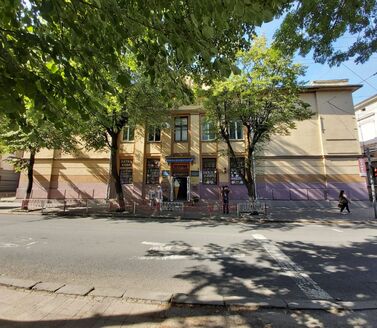
The main entrance from the street Melnychuk in the form of a portico with columns that support the veranda of the second floor. The building has a complex configuration in plan, with risalites on the main and courtyard facades. The planning is mixed in the old part and corridor in the new.
The foundations are rubble, the plinth is high. The walls are brick, plastered. The ceilings are flat on wooden beams, the roofs are gabled on wooden rafters. The roof is sheet metal.
The facades are divided horizontally by inter-floor and window beams. The first floor is rusticated. The risalites and the veranda above the portico are finished with a triangular pediment. The windows are rectangular on the facades, arched at the entrance, decorated with casements, triangular sandrikas and pilasters of the Corinthian order.

In 1921, a Jewish elementary school was located in the building, and from 1925, a Jewish gymnasium also operated here.

The building was expanded twice more. In 1931, a two-story volume with a basement floor was added to the existing left wing, in the Constructivist style. The Jewish community spent 23,000 zlotys on the purchase of land, 6,500 dollars and 3,400 zlotys on construction.
And, finally, in 1937, a third floor was added at a cost of 10,000 zlotys (arch. L. Lippman).
The main entrance from the street Melnychuk in the form of a portico with columns that support the veranda of the second floor. The building has a complex configuration in plan, with risalites on the main and courtyard facades. The planning is mixed in the old part and corridor in the new.
The foundations are rubble, the plinth is high. The walls are brick, plastered. The ceilings are flat on wooden beams, the roofs are gabled on wooden rafters. The roof is sheet metal.
The facades are divided horizontally by inter-floor and window beams. The first floor is rusticated. The risalites and the veranda above the portico are finished with a triangular pediment. The windows are rectangular on the facades, arched at the entrance, decorated with casements, triangular sandrikas and pilasters of the Corinthian order.

INTERESTING FACTS

  • The house was built at the end of the 19th century.
  • In 1944-45, Ivan Franko's son, Taras, was the teacher of the German language at the school located in this building at that time.
  • Since 1996, the building has been part of the complex of buildings of the Economic and Legal Institute (later the West Ukrainian Economic and Legal University). It is now in an emergency state.
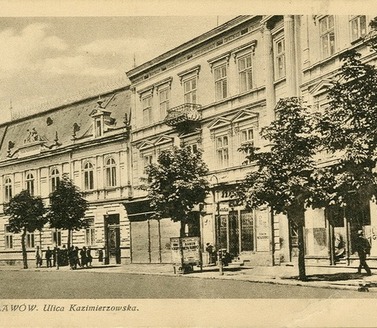
  • The house was built at the end of the 19th century.
  • In 1944-45, Ivan Franko's son, Taras, was the teacher of the German language at the school located in this building at that time.
  • Since 1996, the building has been part of the complex of buildings of the Economic and Legal Institute (later the West Ukrainian Economic and Legal University). It is now in an emergency state.