A Mural of the Historical Past of Henichesk and the Sculptural Composition “Cossack Mamay”
On July 7, 2018, in the city of Henichesk, a mural of the historical past of ...
The mural of the work of local artist Liliia Konieva, located on the berth fence on the Henichesk Strait (Tonkyi), depicts the old Henichesk in the locomotive depot area, namely those times when transport operations of passenger and goods traffic led the city’s economy.
The mural of the work of local artist Liliia Konieva, located on the berth fence on the Henichesk Strait (Tonkyi), depicts the old Henichesk in the locomotive depot area, namely those times when transport operations of passenger and goods traffic led the city’s economy.

On July 7, 2018, in the city of Henichesk, a mural of the historical past of ...
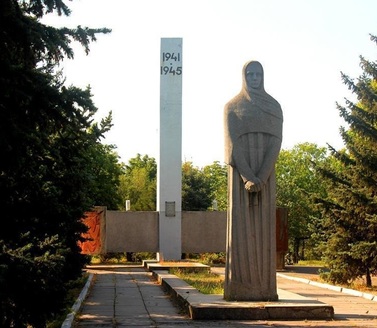
In the place of the present Public Garden of Glory, the first settlers of ...
It all started with the fact that in 1876 a railway line from the Lozova-Sevastopol line was laid in Henichesk. A grain stream flowed through it to the port, and salt and shell sand were carried from here for the construction of the railway.Also, until 1917, a passenger train went from Henichesk to Novooleksiivka twice a day.
The first railway station in the city was wooden, but very beautiful and well maintained. The central entrance led through a stonedogleg stair, decorated with flowers.Before the Revolution, the station had two large halls, one of which was a checkpoint with ticket offices and a buffet, and the second one was a waiting room with a stage. Sometimes, an orchestra played there. The floor was paved with multicolored ornamentaltiles.There were steps on both sides of the southern wall of the station, down to the platform. The exit to the trains was paid, according to the apron ticket. The whole station was buried in flowers.
Before the Revolution, during the construction of the port through the Henichesk Strait (Tonkyi), two wooden bridges were built: the county (by Zemstvo) and the Railway. The railway line for the export of salt from the salt minesled from Henicheskto the Arabat Arrow.Salt was mined in the north and south of the Arabat Arrow. At the end of the 1940s, the mining of shell sand began at the Arabat Arrow. Every day, 3-5 trains went along the railway bridge, loaded with at least 60 cars with sand.
A small railway station was located two hundred meters from the bridge. Several times a day, a passenger working train with small cars approached a tiny platform and brought people from Henicheska Hirka, Shchaslyvtseve, and Strilkove. Active sale of agricultural products: milk, meat, butter, eggs, and other foods usually started right on the platform.
In the winter of 1970, hurricane winds of 30–35 m/s, which did not stop for several months, broke out in Azov. As a result, the railway at the Arabat Arrowwas destroyed.
It all started with the fact that in 1876 a railway line from the Lozova-Sevastopol line was laid in Henichesk. A grain stream flowed through it to the port, and salt and shell sand were carried from here for the construction of the railway.Also, until 1917, a passenger train went from Henichesk to Novooleksiivka twice a day.
The first railway station in the city was wooden, but very beautiful and well maintained. The central entrance led through a stonedogleg stair, decorated with flowers.Before the Revolution, the station had two large halls, one of which was a checkpoint with ticket offices and a buffet, and the second one was a waiting room with a stage. Sometimes, an orchestra played there. The floor was paved with multicolored ornamentaltiles.There were steps on both sides of the southern wall of the station, down to the platform. The exit to the trains was paid, according to the apron ticket. The whole station was buried in flowers.
Before the Revolution, during the construction of the port through the Henichesk Strait (Tonkyi), two wooden bridges were built: the county (by Zemstvo) and the Railway. The railway line for the export of salt from the salt minesled from Henicheskto the Arabat Arrow.Salt was mined in the north and south of the Arabat Arrow. At the end of the 1940s, the mining of shell sand began at the Arabat Arrow. Every day, 3-5 trains went along the railway bridge, loaded with at least 60 cars with sand.
A small railway station was located two hundred meters from the bridge. Several times a day, a passenger working train with small cars approached a tiny platform and brought people from Henicheska Hirka, Shchaslyvtseve, and Strilkove. Active sale of agricultural products: milk, meat, butter, eggs, and other foods usually started right on the platform.
In the winter of 1970, hurricane winds of 30–35 m/s, which did not stop for several months, broke out in Azov. As a result, the railway at the Arabat Arrowwas destroyed.